

He is distracted. Too much cricket, too many friends, not enough discipline. He will settle when the exams get serious.
Case Study · Residential Astro-Vastu
Where Prince Kept His
Cricket Bat.
A boy in the seventh grade who could not sit still to study, a corner of the house nobody had thought about, and an honest account of what I think actually changed.
01 · The Situation
He Was Not a Difficult
Child. He Just Would Not Sit.
Prince was twelve, in the seventh grade, and by every account a perfectly ordinary boy. Cheerful, sociable, good with people. Nobody described him as troubled.
But the moment he was asked to study, he wanted to be outside with a bat in his hand. Not occasionally. Every time. Books would be opened and then abandoned. Ten minutes at the desk, then a reason to be somewhere else. His mother, Rekha, had tried the things parents try: rules, rewards, taking the bat away, giving it back, sitting with him, leaving him alone.
What she said when we spoke was that she had stopped knowing whether the problem was him, or her, or the school.
02 · What Everyone Assumed
The Explanations Already
on the Table.
Take the sport away. Add tuition. Fix a timetable and enforce it. All of it reasonable, and none of it had worked.
Where in the house was he actually being asked to study, and what else was living in that part of it?
03 · What the Assessment Found
The Kit Bag Was in the Corner
the Books Should Have Been.
West of south-west
A cricket kit, a bat, and a shelf of toys.
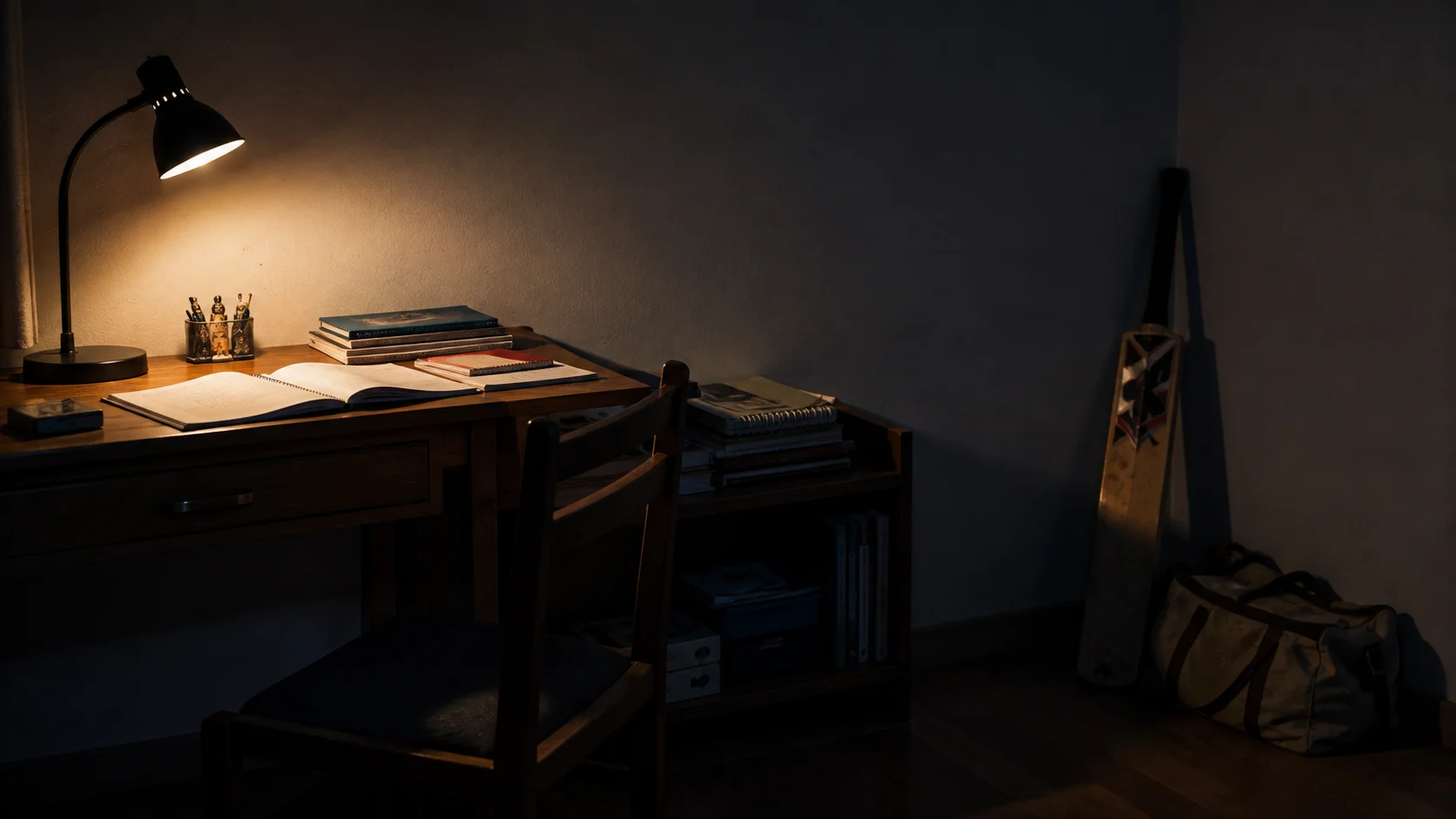
In the framework I work within, the west of south-west is the zone associated with education, discipline and the capacity to apply oneself to something over time. In this house it held Prince's cricket kit, his bat, a pile of unused toys, and a few things that had simply been put there because there was space.
On its own this proves nothing. Plenty of children keep their bats in the same corner and study perfectly well. What made it worth acting on was that this family's difficulty was precisely a difficulty of applying oneself, and this was the zone associated with it.
There is also a plainer observation underneath the framework, and I want to make it before anyone else does. The first thing that boy saw, every time he entered the part of the house where he was supposed to work, was his cricket bag.
04 · What Was Recommended
Nothing Was Taken Away.
Move the kit
The bat and the kit bag were relocated out of the zone. Not confiscated, not hidden. Given a proper place elsewhere in the house.
Clear the rest
The unused toys and the accumulated odds and ends were removed entirely. Most had not been touched in a year.
Put the books there
His school books, his notebooks and his study materials took the corner instead, at his height, visible, not shut in a cupboard.
I was specific with Rekha about one thing: the cricket was not to be treated as the problem. A twelve-year-old who loves a sport is not a defect to be corrected. The bat simply needed somewhere else to live.
05 · What Followed
He Started Sitting There
Without Being Asked.
Not immediately, and not dramatically. Over the following weeks Rekha noticed that the argument had gone out of it. He still played. He still preferred playing. But the daily negotiation about sitting down had stopped being a negotiation.
What she reported to me was that she had found him at the desk twice without having said anything, which had not happened in a very long time.
She was, in her own words, relieved more than anything else. Not because his marks had changed, but because the house had stopped being a place where the two of them argued every evening.
06 · The Honest Answer
Did Moving a Cricket Bat
Make a Boy Study?
Three things happened that afternoon, and only one of them was a Vastu correction.
The kit was moved out of the zone. A corner that had become a dumping ground was cleared for the first time in a year. And his books were given a visible, permanent, dedicated place at his own height, which they had never had before.
Any child psychologist would tell you the third of those matters, entirely on its own terms, with no reference to direction at all. I am not going to pretend otherwise. A child who has a real place to work is more likely to work than a child who does not.
There is a fourth thing as well. Rekha stopped treating the cricket as the enemy. That changes the temperature of a household, and twelve-year-olds are very sensitive to the temperature of a household.
So what I will say is narrower than the story invites. The house had a condition worth correcting on its own terms. Correcting it cost nothing and took an afternoon. What followed was a quieter home and a boy who sat down more easily. Whether the zone explains it, or whether a cleared corner and a mother who stopped fighting about cricket would have done the same, is a fair question. I would rather leave it open than close it dishonestly.
07 · What This Case Teaches
Children Are Read by Their Rooms
More Than We Admit.
Adults can override their surroundings. We work in bad rooms, sleep in noisy ones, and mostly get on with it. Children are far less able to, and far less able to explain what is happening to them.
A twelve-year-old will not say the study corner feels wrong. He will simply want to be somewhere else, and the adults around him will call that a discipline problem.
Before deciding a child cannot focus, it is worth asking what is in the place you have asked him to focus.
08 · Your Home
Worth Checking First.
None of these mean a Vastu condition exists. They mean the environment has not been examined, and examining it is cheaper than another year of arguing.
No fixed place to study
Homework happens at the dining table, or wherever there is space that day.
The desk faces a wall of distraction
A television, a play area, or a window onto where the other children are.
Books are stored out of sight
Shut in a cupboard, while everything else is on open shelves.
The study zone stores something else
Sports gear, unused furniture, luggage, or things nobody has looked at in a year.
The room changed recently
A move, a renovation, or a sibling's arrival shifted where the child works.
It is only this child
One child in the house struggles to settle and the others do not.
Do not start by taking the sport away. Start by finding out what is where.
Start With a Diagnostic
Before You Decide the Child
Is the Problem.
A thirty-minute diagnostic will tell you whether your home contains a condition worth correcting, and just as often that it does not, and that the difficulty is somewhere else entirely. That second answer is worth as much as the first, and it is a great deal cheaper than another year of the same argument.
This case concerns a child's schooling. Astro-Vastu is not an educational, psychological or medical assessment and must never be used in place of one. If a child is persistently struggling to concentrate, please speak to their school and to a qualified professional. Details shared with the family's permission; the name has been changed. Individual circumstances vary and no specific outcome is promised or guaranteed.