

A bad run in the market. Difficult customers. Bad luck, arriving all at once.
Case Study · Astro-Vastu
A House in Jaipur,
and the Question Nobody
Had Asked.
A family moved into the house they had worked fifteen years to afford. Within eighteen months the business that paid for it was close to closing. This is what we found when we read the plan against the chart, and what we deliberately did not claim afterwards.
01 · The Situation
Everything Was Done
in the Right Order.
The family had done nothing wrong. The business had grown steadily for years. The old house was sold, the savings were added, the bank lent the rest, and they moved into a larger home with room for everyone.
Then the ground shifted. Within the first year the business began running short of working capital. Not collapse, at first. Payments arrived later than they used to. Orders that had always closed began to stall. Then the shortfall reached the point where the bank started asking questions about the loan secured against the house itself.
What arrived alongside the financial pressure is what the family described most clearly when they called. A couple who had run a household together for two decades were arguing weekly. Two children had gone from steady school reports to distracted ones. And there was a persistent unease in the house that nobody could name.
Four separate problems, in the family's account. Part of why they called is that nobody had suggested they might be one problem.
02 · The Obvious Explanation
What Everyone Believed
at the Time.
Cut costs. Chase receivables harder. Wait it out. All reasonable, and none of it explained the timing.
Why now? A business that had grown for years did not start struggling at random. Something changed, and the only thing that had changed was the house.
03 · What We Examined
Two Things, Read
Against Each Other.
01
The Plan
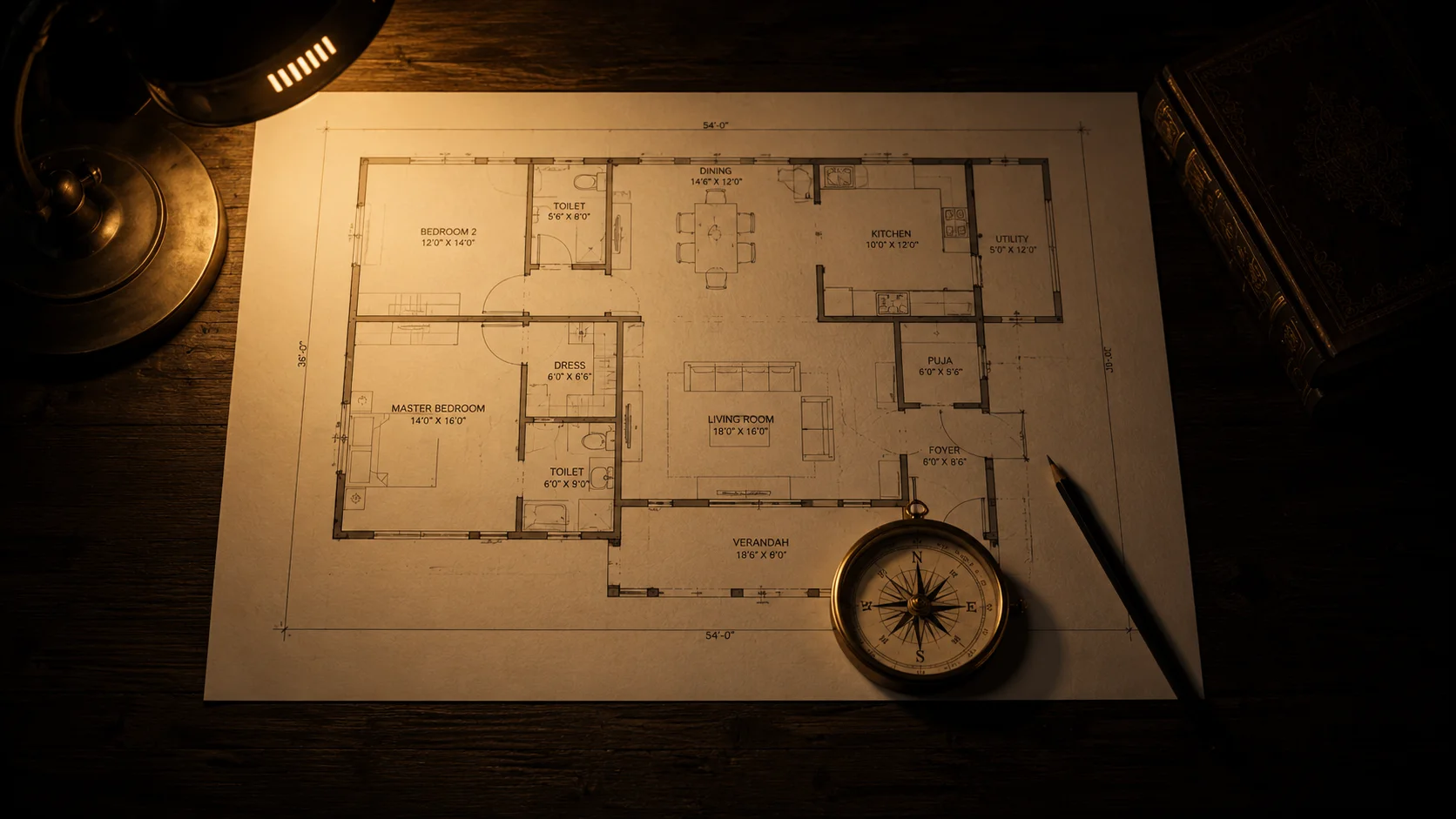
The layout marked to the sixteen directions, the centre established, and each zone assessed against its function and its actual daily use.
InputBuilder floor planOutputZone-by-zone assessment
02
The Chart
The running planetary period for the head of the household, and the transits active across the months when the difficulty began.
InputBirth detailsOutputPeriod and timing analysis
The reason for reading both is straightforward. A defect in a building is a constant. It does not explain why a family lived comfortably for years and then did not. Something must account for the timing, and the space alone never does.
04 · What the Analysis Revealed
Two Findings, and One
Coincidence That Wasn't.
Finding 01
The entrance sat in the south-west.
In the classical framework this zone is associated with weight, stability and holding. An entrance placed here is read as drawing in obligation rather than opportunity. The pada the door occupied is one associated with rising debt and with withdrawal from the outside world.
On its own this proves nothing. The family had lived with a south-west entry in the old house too, without this outcome. The defect was not new to them.
Finding 02
A toilet occupied the west zone.
West is read in relation to gains and to what is retained. A drainage function placed there is read as carrying away what should be accumulating.
Also ordinary. Thousands of houses have it, and most of those households are fine.
What made the findings significant was the third thing: the period running in the chart was one that puts pressure on borrowing, obligation and cash flow, and it had begun within months of the move.
Space and timing pointing at the same thing, at the same moment.
05 · What Was Prioritised
What We Recommended,
and What We Did Not.
Not the toilet
Structurally central to the floor's plumbing. Relocating it meant cost the family did not have.
The threshold
A metal treatment at the entrance, done in an afternoon and reversible if they moved.
The west zone
A metal treatment around the fixture, paid for out of pocket rather than out of borrowing.
An expectation
That the household would feel different before the accounts did, and that the period had a duration.
The decision not to move the toilet matters more than either correction. A recommendation the client cannot afford to implement is not a recommendation. It is a bill.
06 · What Happened
The Months That Followed.
The business recovered over the following months. The immediate threat to the house passed. The arguments became less frequent, then stopped being weekly. The children's reports improved. The unease nobody could name was gone.
07 · What We Did Not Claim
The Part Most Case Studies
Leave Out.
Three things changed in that window, not one.
- The corrections were made.
- The planetary period ran its course, as periods do.
- The family cut costs, chased receivables and made decisions under pressure that they had not needed to make before.
We are not able to separate those threads, and we will not pretend otherwise. A practitioner who tells you a brass strip saved a business is selling you something.
What we can say is narrower, and we think more useful: the space had been working against them, it stopped, and the family's own account is that the household felt different within weeks of the change, before the business did. Whether that ordering means what we think it means is a fair question. We would rather leave it open than close it dishonestly.
08 · What This Case Teaches
The Defect Explains What Is Possible.
The Chart Explains When.
This case is not here because the corrections were clever. They were not. A metal strip at a threshold is among the most ordinary interventions in the practice.
It is here because of the sequence. The family had been given advice before. What they had not been asked for was a birth date. Every consultant who looked at that house saw the same south-west entrance, and any of them could have named it. What none of them could explain was why a family that had lived with a south-west entrance for years was suddenly struggling, because that question cannot be answered from a floor plan.
Read separately, the two produce generic advice and expensive corrections. Read together, they produce a short list of things worth actually doing.
Your Situation
Does This Apply to Your Chart
and Your Space?
A case study cannot see your floor plan, and it cannot see your birth chart. A thirty-minute diagnostic can. You will leave with a written Audit Report setting out what was found. Findings, not fixes, and no obligation to go further.
Details shared with the family's permission; the name has been changed. Individual circumstances vary and no specific outcome is promised or guaranteed. Astro-Vastu is offered for personal insight and planning. It does not constitute medical, legal or financial advice.