Did they ask to see the plan?
An object recommended without a floor plan was not recommended for your building.
Need help? Email me here or call +91 90292 11166


Practice; Questioning the Rules
Three rules almost every Indian household has been given, examined honestly. Not to replace them with three new certainties, but to show how little sits behind any of them.
01 · Where the Rules Come From
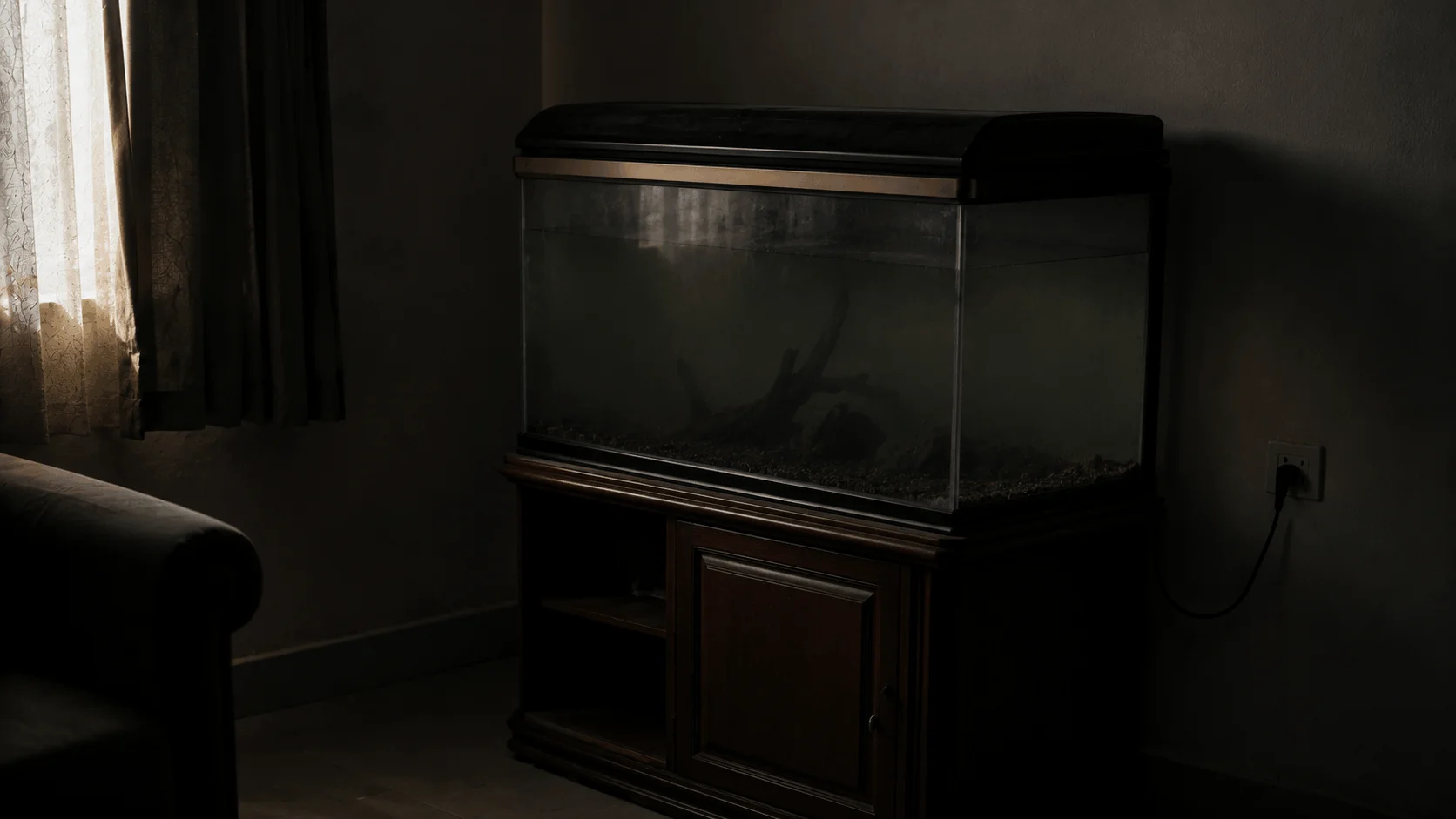
Ask ten households in India why the aquarium is in the drawing room and you will get the same answer ten times: it brings wealth. Ask who said so and the answer becomes vaguer. A relative. A consultant. Someone at a wedding. A shop that sold both the tank and the reason for owning it.
This is how most Vastu rules travel. Not through texts, which are older and stranger and much less certain than people assume, but through repetition. A guideline gets passed along, loses its conditions on the way, and arrives as a rule.
I am not going to tell you these three are wrong. I am going to show you how little sits behind them, and then admit the same is true of a great deal that gets sold as the correction.
02 · The Aquarium
The reasoning usually offered is that water represents flow, flow represents money, and therefore a tank of water in the right corner produces money. Each step in that chain sounds reasonable and none of them is examined.
What the tradition actually treats carefully is water as an element in a space: where it is stored, where it drains, where it enters. Those are structural questions about a building. An ornamental tank is not the same category of thing as a well, a tank on the roof, or the direction your drainage runs, and treating it as though it were is a category error rather than a tradition.
There is also a plainer objection. A neglected aquarium is a stagnant one. Anyone who has kept fish knows the tank that was going to change the household's fortunes is frequently the cloudiest object in the room by the following summer.
If you enjoy the fish, keep them. If you bought them as a financial instrument, they are not one.
03 · The Ganesha at the Door
I want to be careful here, because this is somebody's devotion and not a decorating choice.
I am not going to tell you to remove a murti from your home, and I would think less of any consultant who did. If a Ganesha at your entrance is an act of faith, it is not mine to audit, and nothing in this article should be read as saying otherwise.
What I will say is narrower. Devotion and structural correction are two different categories. Placing a deity is the first. It is not the second, and it does not become the second because a consultant charged for it.
The confusion arises when a murti is prescribed as a remedy — placed at an entrance to fix something, by someone who has not examined which of the thirty-two entrance positions that doorway actually occupies, or what the zone is carrying.
An entrance is a functional thing. Its position determines a great deal about how a building is read. If there is a difficulty associated with it, the difficulty concerns the doorway. Adding an object beside the doorway does not alter the doorway.
Keep the Ganesha. Be sceptical of anyone who sells you one as a repair.
04 · Three Doors in a Line
This is the one where the evidence is easiest to check, and it does not go the way the rule suggests.
Aligned doorways are a deliberate device in a great deal of successful architecture. An enfilade — a run of rooms whose doors line up — is a defining feature of European palaces and of a good number of large houses that have stood, occupied and prosperous, for centuries. Temple architecture across India frequently aligns a sequence of thresholds from the entrance to the sanctum. That alignment is the point. It is what draws a person through.
A rule that ruin follows from three aligned doors has to account for the buildings where seven of them align and nothing of the kind occurred.
There are real questions to ask about aligned openings — draught, privacy, how quickly a space is crossed rather than occupied. Those are worth discussing. Ruin is not.
05 · The Honest Answer
It would be easy to end here having replaced three confident claims with three new ones. I am not going to do that.
I cannot prove an aquarium does nothing. I cannot prove a murti at a doorway has no structural effect. I can point out that nobody has shown the opposite either, and that the confidence with which these things are asserted is out of all proportion to what anybody actually knows.
That is the real difficulty, and it is not confined to these three. Much of what is sold as Vastu correction in India today — the pyramids, the tapes, the strips, the crystals — arrives with the same absolute certainty and the same absence of anything behind it. Including, sometimes, from people who would agree with everything else in this article.
What the tradition offers, read carefully, is a framework for examining a building: its orientation, its zones, what each part is used for, where the weight and the water and the openings sit. That is a way of looking. It is not a catalogue of objects that fix things, and the moment it is sold as one, it stops being worth anything.
06 · A Better Test
These will not tell you whether a remedy works. They will tell you whether the person recommending it has examined your house or is reading from a list.
An object recommended without a floor plan was not recommended for your building.
Not what it attracts. What specific condition, in which zone, it is intended to address.
If the same object is recommended to every household, it is a product, not a diagnosis.
A consultant who has never told a client their house is fine is not examining houses.
The fourth question is the one I would weight most heavily. It is also the one that costs a consultant money to answer honestly.
07 · What This Leaves
Removing three rules does not leave you with an empty framework. It leaves you with the part of it that was always doing the work: a careful reading of orientation, zones, function and use, applied to one specific building, by someone willing to say when there is nothing to correct.
That is a smaller claim than the aquarium came with. It is also the only one I can stand behind.
Start With a Diagnostic
A thirty-minute diagnostic examines your actual floor plan and tells you what, if anything, is worth attention — and in what order. Often the answer is that the difficulty is somewhere else entirely, which is a cheaper answer than the one you were about to buy.
Nothing here is a criticism of anyone's religious practice, and nothing in it should be read as advising against an act of devotion. Astro-Vastu is offered for insight and planning and does not constitute medical, legal, financial or investment advice. Individual circumstances vary and no specific outcome is promised or guaranteed.
Astro-Vastu · Jyotish · Clarity