

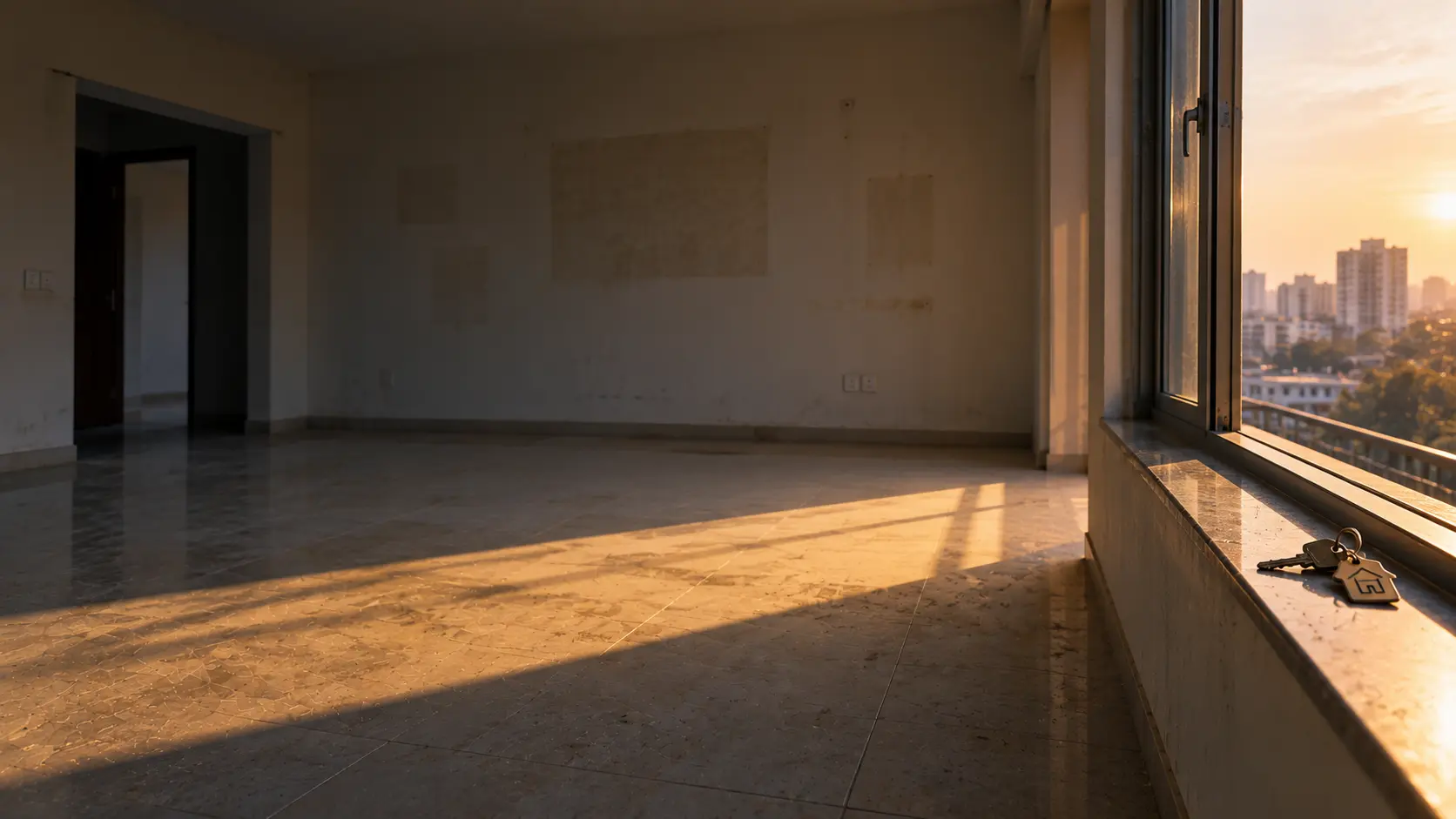
A property that will not sell is almost always explained the same way. The market is slow. The price is high. The broker is not working. Sometimes all three are true. But there is a particular pattern that shows up in consultations often enough to be worth naming: the enquiries arrive, the visits happen, two or three buyers seem serious, and then each one goes quiet. The asset is not unwanted. It is simply not concluding.
When that pattern repeats, a consultant looks at two things before touching the price. The space the seller is living in, and the placements in the seller's chart that govern property and gains.
The four zones that carry a sale
A sale is not a single event. It is four separate functions happening in sequence: your effort has to convert into something, buyers have to find you, money has to move, and other people have to cooperate. Each of those sits in a different part of a building.
West, the zone of gains
The West governs the yield of effort. This is where work is supposed to turn into return. When a toilet, a septic tank, a dustbin or a washing machine occupies this zone, the classical reading is of gains that drain rather than accumulate, and property matters are specifically named among the things affected. Heavy air and green elements here dilute the same function.
The correction is subtractive first. Remove what does not belong before adding anything. Where a toilet cannot be moved, a metal strip at the threshold is the traditional treatment. A framed village scene on the western wall, land under cultivation, houses, people, is the classical enhancement for this zone because it holds the idea of land that yields.
East, the zone of connection
Buyers arrive through people. Brokers, neighbours, colleagues, the cousin who knows somebody. The East governs social and commercial connection, and when it is blocked by heavy storage, a toilet or a store room, the reading is of a listing that does not travel far enough to reach the person who would have bought it.
Clear the zone, let light in, and a brass sun on the eastern wall is the standard enhancement.
South East, the zone of cash movement
Token money, advance, the first transfer. The South East holds the fire element and governs the moment a transaction actually moves. Blue and black in this zone, water elements, or a toilet, all read as a dampened fire, and the corresponding symptom is a deal that is agreed but never funded. The buyer keeps postponing the advance.
A small red bulb kept lit in this zone is the simplest activation. Removing the blue is more important than adding the red.
North West, the zone of support
A property sale runs on other people's cooperation. The agent, the society office, the buyer's bank, the lawyer clearing the title. The North West governs that support and is an air zone, so fire elements here, red walls, a heater, a boiler, work against it. Keep it cool, light and moving.
The energy fields underneath
The Vastu Purusha Mandala maps forty five energy fields across a plot, each one a named devta governing a specific life process. Two of them are directly relevant when land or a building is being sold.
Aryama, in the eastern band, governs connection with land and property itself, along with the entertainment trades. A weak Aryama is read as a severed link between the seller and the property market. It is the reason the East zone matters more in a property sale than it does in most other consultations.
Sugreev, in the western band, is the receiving power. It governs whether what is owed to you actually reaches you. A seller who agrees a good price and then finds the payment schedule stretching out is being described by this field.
The main entrance
The entrance is the point where the outside world is admitted into your space, and the mandala divides the perimeter into thirty two segments, each named for a devta with its own character. Not all of them are hospitable to a transaction.
In the southern band, the segments belonging to Mrig and Bhringraj are traditionally read as effort that dissipates, which in a sale means a long stretch of activity with nothing to show for it, and the segments near Pitra as a slow withdrawal from the world along with accumulating obligations. In the western band, the segments toward Asur and Varun are associated with financial instability that makes clean closure difficult.
The favourable western entrances are the ones held by Sugreev and Pushpdant, both read as smooth receiving and unobstructed dealings.
Where the entrance sits in an unhelpful segment and cannot be relocated, which is nearly always the case in a flat, the treatment is a strip of brass or yellow metal set into the threshold. It is not a demolition. It is a boundary marker, and it is the standard remedy for exactly this situation.
What the chart adds
The building tells you what is happening in the space. The chart tells you why it is happening now rather than two years ago.
For a property matter, three houses carry the weight. The fourth house governs land, buildings and immovable assets. The tenth governs standing and the visible outcome of effort. The eleventh governs gains and the completion of what was undertaken. A sale needs all three to be reasonably clear.
The timing usually explains itself through the running Mahadasha and Antardasha, and through the transits touching the fourth house or its lord. Saturn moving over the fourth house or aspecting its lord is the most common signature in a stuck sale. The property is not unsellable. It is being made to wait, and the waiting has a defined period.
This is where astrology earns its place in a property consultation. It will not tell you the sale is guaranteed. It will tell you whether the current stretch is a genuine window or a period where holding is the more sensible decision, and that single piece of information changes what you do about the price.
A working sequence
If you want to act on this without a consultation, the order matters more than the individual items.
- Inspect the West for a toilet, a dustbin or a washing machine. Remove what can be removed. Treat what cannot.
- Clear the East of heavy storage and let it breathe. Add the brass sun after it is clear, not before.
- Take the blue and black out of the South East. A small red bulb goes in once the zone is neutral.
- Remove fire elements from the North West and keep the zone light.
- Set a brass strip at the threshold if your entrance falls in one of the difficult segments.
- Have the chart read for the fourth house and the running dasha before you make the next price decision.
What none of this can do
This is the part most articles on the subject leave out, so it is worth stating plainly.
A property does not sell because of a village scene on a wall. A property sells because of price, title, location, timing and the competence of the person representing it. If the title has an encumbrance, no zone correction will clear it. If the asking price is fifteen percent above the last three registered transactions in the same building, the space is not the problem. If the property has a genuine defect that every visiting buyer notices, that defect is doing the work, not the entrance.
What a Vastu reading does is remove a set of obstructions that are otherwise invisible and unaccounted for. When a sale concludes after a correction, several things have usually changed at once: the seller has become more decisive, the price has been revisited, a different broker has been engaged, and the zones have been cleared. Those threads cannot be separated afterwards, and anyone who tells you they can is selling you certainty rather than a consultation.
The honest claim is narrower and more useful. The space stops working against the transaction. What happens next is still governed by the market.
Does this apply to your chart and your space?
An article cannot see your floor plan. A 30-minute diagnostic session can.
Start With a Diagnostic